
Skin Science
Shaving with eczema, psoriasis, or dermatitis: a skin-safe guide
Apr
Eczema and psoriasis don’t care about your swimsuit plans. But shaving flares aren’t inevitable if you pick the right tool and the right timing.
TL;DR
- Shave during remission, not during a flare. Active eczema patches should never be shaved.
- Use an electric shaver with a blade guard to eliminate direct blade-to-skin contact — the #1 cause of flare triggers during shaving.
- Skip every product with fragrance, alcohol, or menthol within 2 hours before/after shaving.
- Moisturize within 3 minutes of drying — this is the most important step.
Why shaving aggravates eczema and psoriasis
Both conditions involve a compromised skin barrier. Every shave creates micro-wounds. On healthy skin, these heal invisibly in hours. On eczema- or psoriasis-prone skin, they become inflammation loops — the barrier can’t close fast enough, so irritants penetrate, so the immune system over-reacts, so more inflammation. That’s a flare.
The two highest-risk shaving practices for chronic skin conditions:
- Dragging a razor blade across skin — even a sharp, new razor causes micro-tearing
- Using scented shaving cream — fragrance is the #1 allergen in contact dermatitis
How an electric shaver with a blade guard changes the math
Electric shavers with a hypoallergenic guard (like Karixe Glide) are dermatologist-preferred for chronic skin conditions because:
- Blades never touch skin directly — the 0.5mm guard maintains a buffer. No micro-tearing.
- No shaving cream required — eliminates the #1 fragrance vector.
- Gentle pressure — the floating head follows curves, so you don’t press hard to force contact.
- Waterproof — you can shave in the shower while your skin is warm and well-hydrated, the ideal state for barrier-compromised skin.
A safe routine for eczema / psoriasis / dermatitis skin
- Check the zone. If you see active eczema (scaly, red, weeping), skip that spot entirely. Shave around it.
- Warm shower 3–5 minutes. Opens pores, softens hair. Cool water at the end to close pores.
- Pat dry. Don’t rub. Rubbing inflames already-sensitized skin.
- Electric shaver, gentle circular motion. No pressure. No shaving cream.
- Rinse with cool water. Pat dry again.
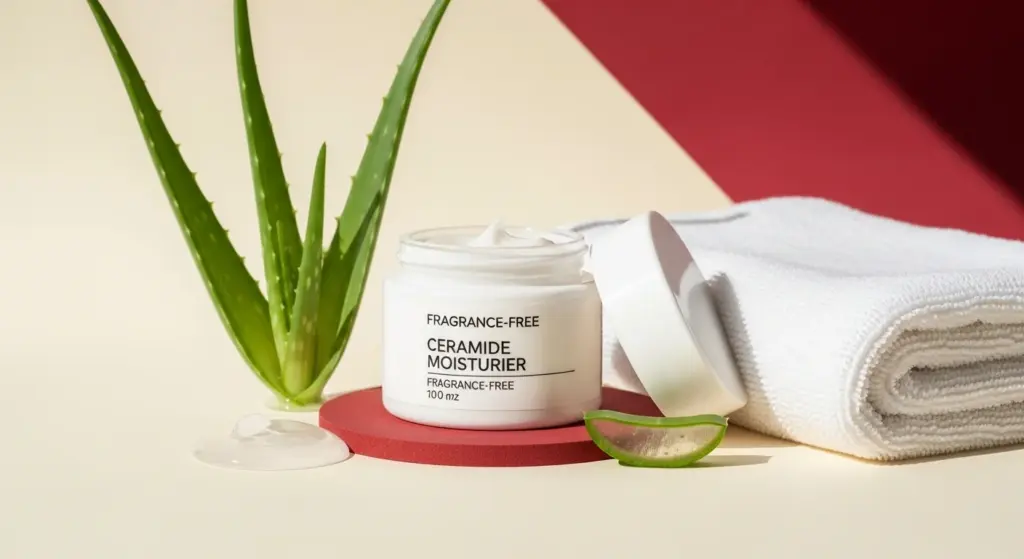
- Apply a ceramide moisturizer within 3 minutes. CeraVe, Eucerin, La Roche-Posay Lipikar — these are dermatologist-approved. Fragrance-free only.
- Wait 24 hours before exfoliating or applying any treatment product (like retinol or AHAs) to the shaved zone.
What to avoid entirely
- Waxing. Pulls the epidermis, devastating for chronic skin. Skip.
- Depilatory creams. Chemical hair removal on barrier-compromised skin is a flare trigger 90% of the time.
- Scented shaving cream / gel / foam. Every fragrance is a potential allergen.
- Alcohol-based aftershaves. Burns open skin.
- Dry shaving. Even an electric shaver prefers damp skin for the smoothest cut.
When to consult a dermatologist
- A shave causes a flare that lasts more than 5 days
- You develop new patches of eczema in the shaved area
- You’re on immunosuppressants (higher infection risk)
- You’ve tried everything and still can’t shave without flaring
Your dermatologist may recommend prescription-grade barrier repair creams or suggest laser hair removal for permanent relief (works well on stable, dark hair).
Karixe and eczema skin
Karixe Glide was designed around the same principle dermatologists teach: no direct blade contact. The hypoallergenic guard, waterproof body, and 90-day money-back guarantee mean you can try it with your exact skin and condition. If it doesn’t work, we refund everything and pay return shipping — no questions asked.
Related reading
This article is educational, not medical advice. Always consult a board-certified dermatologist for flare management and treatment.
